A Level Geography
Examination Board: AQA


What Will I learn?
Students will get the opportunity to: engage with the relationships between human populations over space and time and their physical environment at a variety of scales from local to global, and consider their own role relative to the issues being studied, and the values and attitudes of others, including decision makers. Our students will study the following:
Physical Geography
Water & Carbon Cycles – The major stores of water and carbon at or near the Earth’s surface and the dynamic cyclical relationships associated with them.
Coastal Systems & Landscapes - Coastal processes, landforms, sea level changes, flooding and protection.
Hazards – The hazards that are posed to human populations in dramatic and catastrophic fashion. Students investigate the many dimensions of the relationships between people and their environments.
Human Geography
Global systems and governance – globalisation; the economic, political and social changes associated with technological and other forces, and how they have been a key feature of the global economy and society.
Changing places – People’s engagement with places, their experience of them and the qualities they ascribe to them.
Contemporary Urban Environments - How towns and cities are changing over space and time.
Key skills learnt: A variety of investigative, cartographic, graphical, applied ICT and statistical skills. Completion of a geographical fieldwork investigation in a coastal or urban environment in Portugal.
How Am I Assessed?
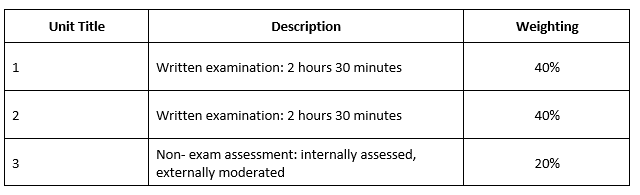
What Career Options Do I Have?
This Advanced Level specification provides opportunities for progression to courses in higher education in all related subjects, including English and Modern Foreign Languages, History and Politics, Psychology, Music and Dance. It is supported by all higher education institutions as an entry qualification in other subjects. Equally, it is a highly enabling subject for students wishing to pursue a career that involves communication such as law, education and the arts and media industries. Business employers, for instance, particularly like to see drama on a prospective employee’s CV, because it suggests a high level of presentational and interpersonal skills which they consider to be vital in today’s competitive working environment.