Examination Board: AQA
What Will I learn?
The AQA Product Design specification is a two-year course that provides a continued progression of knowledge, understanding and skills built and studied at GCSE. The qualification is linear which means that students will sit all their exams and submit all their non-exam assessment at the end of the two-year course.
This creative and thought-provoking qualification gives students the practical skills, theoretical knowledge and confidence to succeed in a number of careers. Especially those in the creative industries.
Students will investigate historical, social, cultural, environmental and economic influences on design and technology, whilst enjoying opportunities to put their learning into practice by producing innovative, relevant prototypes of their chosen products gaining a real understanding of what it means to be a designer, alongside the knowledge and skills sought by higher education and employers.
Within the course, students will visit local businesses, factories and Universities to improve students’ understanding of industrial practices and the design industry.
Students choosing the course will:
- Identify market needs and opportunities for new products and use creativity and imagination when applying iterative design processes to develop and modify designs. To design and make prototypes that solve real world problems and are suitable for commercial manufacture, considering user wants, needs, aspirations and values.
- Take risks, showing innovation and enterprise while considering their role as a responsible designer.
- Be able to create and analyse design concepts and use a range of skills and knowledge from other subject areas, including mathematics and science, to inform design decisions and the application or development of technology.
- Demonstrate a high level of literacy and numeracy throughout their coursework and examination.
- Develop a critical understanding of the wider influences on design and technology, including cultural, economic, environmental, historical and social factors.
- Be able to work collaboratively to develop and refine ideas, responding to feedback from users, peers and expert practitioners.
- Develop an in-depth knowledge and understanding of materials, components and processes associated with the creation of products that can be tested and evaluated in use.
- Develop intellectual curiosity about how the design and manufacture of products and systems and their impact on daily life and the wider world.
- Enhance their IT skills to support design and development through the use of Pro Desktop, Adobe Photoshop, 2D Design and Google Sketch-up in order to improve their skills for further education in the design industry.
- Design and create Projects to briefs that are open and therefore could link to product design, architecture, interior architecture, furniture design, graphic design etc.
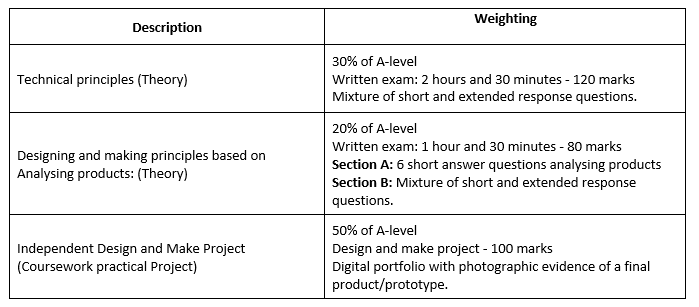
How Am I Assessed?
What Career Options Do I Have?
The course provides students with a wide range of options following completion. Here are a few;
- Product design
- Graphic Design
- Architecture
- Interior Architecture
- Architectural Technology
- Industrial Design
- Furniture Design
- Automotive and Aviation Design
- Landscape Architecture
- Set Design
- Theatre Design
- Design Engineer
- Animator
- Illustrator
- Exhibition Designer
- CAD Designer
- Furniture Design Technicians
The possibilities are endless